Welcome To My Blog


Ever wonder what it's like to be in that moment between struggling artist and published author? Read on and find out.


Saturday, February 11, 2012

Interview with M. Scott Verne - Part I

            As I mentioned in my interview with Steve Crompton, I contributed a story to the City of the Gods anthology that is being released this month. In addition to all of the obvious benefits and bits of coolness that you would normally perceive to be attached to such an event it also gave me a chance to work with M. Scott Verne. And of course a chance to interview him about the creative process.
 
            M. Scott Verne is the co-creator of the City of the Gods world. He has co-written the CotG novels, the CotG Map Pack, and this anthology. He spends a lot of his time researching the Knights Templar and regularly posting at Deadline Hollywood, with opinions on the latest Fantasy and Science-Fiction movies and TV shows.
 

Randy:  First off, are you related to M of MI6? And if so, can you get me James Bond’s autograph?

M:  Ha ha… No Afraid I can’t – State secret as to where they are at any given time…  I can’t even tell you what “M” stands for…
 

Randy: Where did you come up with the idea for City of the Gods?

M:  I’ve always been into speculating about history (both real and imagined) and I’ve always be fascinated about the fall of empires like Egypt, Rome or the Aztecs (for example) One thing that’s always sort of hovered in the back of my mind was the idea that what if these civilizations fell because their gods left them?  Then the question becomes “Ok if the gods left Earth, where did they go?  And why did they leave?”  So that’s the beginnings of the whole concept that eventually led to the novels.   As we wrote it though, we tried to NOT write a standard fantasy novel where there’s a magic item to find on a quest; the hero always does the right thing and they fall in love at the end.  Its not like that.  There are times when you are reading it and you think “oh, I know what happens next”… and then it doesn’t.   It keeps you reading to see what DOES happen.  Then there’s the whole mystery of the girl; Who is she?  Where did she come from?  What to all these clues mean?    Its almost like a Fantasy/Mystery novel in some respects.
 

Randy: What kind of reaction to the City of the Gods novel are you getting so far?

M:  Everyone who had read the book has loved it and wants us to write the sequel.  We’ve gotten some great reviews so far!  See some of them at our Amazon page…


Randy: How was it to work with a group of writers to do the upcoming anthology?

M:  I love working with other creators, and they came up with some great ideas for stories using characters and the “City of the Gods Universe.”  The whole idea of doing an Anthology emerged when some writers asked if they could participate in some way, so we opened up our short story project to anyone that could do a good job writing a CoG (City of the Gods) story.   Sometimes we assigned characters to specific people; other times, they would suggest an idea they had for a story and we worked out a way to make it fit into CoG. We did have a few story ideas that were suggested that didn’t fit.  For example, someone had a story idea about playing cards applying for membership to live in the City of the Gods – It was too whimsical for our universe, (though it might make a very funny story)  
 

Randy: Tell me about some of the authors in the anthology.

M:  It’s a great cross-section of the new and experienced authors including Tunnels & Trolls creator, Ken St. Andre. Published novelist Jefferson Swycaffer; Jay Allen Sanford who has written for Twilight Zone Magazine and works as a biographer; Wendall Brown who’s written screenplays and game designs and of course YOU, who has also designed many games and written many stories!  You all did great stories for us in a variety of styles and tones. We also have a mythic story by Bram Stoker and one by Edgar Allan Poe!  It’s uncanny how well their stories fit right into the CoG Universe! 


Randy: What else can you tell me about the upcoming anthology?

M:  Its a collection of new illustrated stories featuring many of the gods of myth and legend.  Each story has a least one character from the first novel. Some of the stories me and Wynn did, are scenes that could have appeared in the novel, but we didn’t put it in., Travel to Olympus, the Celtic Realm, the Grand Pyramid of Horus and walk the streets of the City of the Gods. With tales of dark fantasy, touching pathos, swashbuckling adventure and humorous hijinx, you'll experience the many moods of the gods. Perfect or for anyone who just wants to read new tales about the classic deities of our past or as an introduction to the City of the Gods universe. 152 pages with 60 illustrations.
 

Randy:  Will you be doing another anthology for City of the Gods?

M:  Yes and we’ll be looking to see who else wants to write for it.  Its open to anyone who is familiar with City of the Gods, so other than reading the novel, (or at least skimming it) anyone can enter.  Details will be posted at www.CityoftheGods.com


(Part 2 of the interview will be posted next Saturday, and then I'm afraid I'm taking a week off to move. However, I have an especially delightful interview after that. Delightful to me anyway.)


Saturday, February 4, 2012

Interview with Steve Crompton - Part II

Before I continue with the second part of the Steve Crompton interview, I am going to mention the City Of The Gods anthology, because I am one of the contributing authors. Steve was kind enough to work up this blurb about it so that I could post it here.


Mythic Tales: City of the Gods Vol1

Authored by M.Scott Verne, Wynn Mercere, Ken St. Andre, Jay Allen Sanford, Randy Lindsay, Wendall Brown, Edgar Allan Poe, Bram Stoker
Illustrated by Gustave Doré, Liz Danforth, Steve Crompton

A collection of new illustrated stories featuring many of the gods of myth and legend. Travel to Olympus, the Celtic Realm, the Grand Pyramid of Horus and walk the streets of the City of the Gods. With tales of dark fantasy, touching pathos, swashbuckling adventure and humorous hijinx, you'll experience the many moods of the gods. Also includes 'forgotten' stories by Edgar Allan Poe, and Bram Stoker with numerous illustrations by legendary Gustav Dore. Also Perfect or for anyone who wants to read new tales about the classic deities of our past or as an introduction to the City of the Gods universe. 152 pages with 60 illustrations.


Now, on with the interview.


Randy: Have you ever tried to do a comic without any dialogue?

Steve:  I haven't – but many have successfully, but as a reader I always feel cheated when I get a story with no text.  It’s only half a comic!  LOL
 

Randy: How has your art style developed during your career?

Steve: I’ve gone through many “phases” in the last 30 years, so I just have to hope that my art is getting better at least.


Randy: If you’re working on a story and get stuck, can you switch to art mode? Or do both of those skills draw from the same creative source?

Steve:  I’m usually working on about 10 projects at once, so if I get stuck, I switch to a different project until the muse strikes again.  Eventually the solution to the other problem will bubble up from my subconscious.
 

Randy: Is it easier to do art for your own stories than it is for stories written by other authors?

Steve:  Probably – I’m surprised by how many artists I met that want to do comics but don’t have any ideas for stories!  That's the least of my problems.  I have stacks of ideas for stories I’ve never gotten round to.
 

Randy: Because of your work in comics, are you used to working in short sound bites? And does that make it harder for you to write longer pieces of fiction?

Steve: Really all my writing is comics, so I don’t know how to answer that question, but that’s probably true.


Randy: Do you ever think of comics being a format similar to a screenplay?

Steve: Very!  I think that’s why so many comics ARE made into movies.  The transition is much easier to pull off. Good verses evil; colorful characters, action, concise storylines  - these things translate well.  Many novels often have complicated subplots, long scenes, moods and themes that often don’t translate well to film. (Without making major changes) 
 

Randy: Specifically relating to your work on the City of the Gods books – is there one mythology that is harder to illustrate than others?

Steve:  When I did the art for City of the Gods, the idea was to be able to pull from classic imagery to create new places and situations.  We wanted to be true to the original look of the gods, but at the same time make all the art feel like it was all in the same place and style.  So finding Mayan or African imagery that would work in the book with the rest of the art was some of the trickiest stuff to do.  
 

Randy: Do you write stories to fit pictures or do you create art to fit the story? Or is it a combination of both?   

Steve: Both – combining art and story is often a collaborative process to try and get the two to merge as perfectly as possible.  Things get tweaked all the time to make the comic art match the script.  We did some of that in the City of the Gods book as well. Mostly in regards to how some of the characters looked, or what they were wearing.
 

Randy: Do you think the story lines in comics are taken less seriously than those encountered in novels and screenplays?

Steve:  Yes - Especially in the US.


Randy: How long does it take to write and illustrate a comic?

Steve:  Anywhere from months to years!  I can write a script in a few days.  Getting all the art and lettering done is the hard part!
 

Randy: I’ve seen you draw and you can knock out a simple illustration pretty quickly. Is that something that comes in handy when you’re doing book/comic signings and other sorts of promotions?

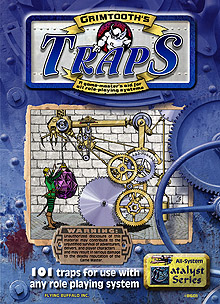
Steve:  Sure!  I do sketches for fans at cons all the time.  I often sign the Grimtooth Traps books or the Nuclear War Card games and include a sketch on the box lid or the inside front cover!  At comic cons, people often have sketchbooks they want artist to draw in,


Randy: Which is harder to promote; comics or illustrated books?

Steve:  Well I have more experience selling comics, so I would have to say illustrated books are harder, but someone else might give you a totally different answer.
 

Randy: What advice to you have for anyone breaking into the comic industry?

Steve:  Make sure you have another skill you can fall back on!  It’s a very hard industry to make a living in right now.  Put together some really good sample and go to a comic-con where you can leave sample with publishers.  If you are new – prepare to work for very little money just so you can prove you can do the work.  Same holds true for illustrating books or games.
 

Randy: How was it to work with M. Scott on the City of the Gods project?

Steve: Wynn and Scott were great and they gave me the freedom to enhance their story with the best art I could put together for their novel.  The idea was to make the book look like the kind of books they published 150 years ago, with classic engravings and illustrations every few pages.  They don’t really make books like that any more, so it was really fun doing something different like that.  If you want to see book some actual pages from the book, go the Amazon page and you can see the first 20 pages for free. Just click on the look inside feature once you get to the Amazon page. You can really see how the art and the story work together.  Here’s the link: http://www.amazon.com/gp/product/1456547100/ref=cm_cd_asin_lnk
 

There’s a free sample chapter of the book at www.cityofthegods.com


Saturday, January 28, 2012

Interview with Steve Crompton - Part I

            With this post I am expanding the pool of creative talent that I’m interviewing. In the next few weeks I plan to share the discussions I’ve had with an artist, a musician, and the creator of the City Of The Gods chapter books and related products. What all of them have in common with the subject of authors in training is that they are writers as well. I hope looking at different forms of the writing craft will at least be entertaining and possibly educational as well.

            First on the list is a good friend of mine, Steve Crompton. Steve is an artist and we have collaborated on game related projects over the last twenty years. He is the Art Director for Flying Buffalo Games, the Art Director for Twisted Entertainment, and has worked as a graphic artist in Phoenix for nearly 30 years.  Here’s a sample of his art.


            I interviewed Steve primarily because of his work in the comic industry. The idea of one person writing and illustrating a story in comic form really intrigued me. How do the two forms of artistic expression blend together? Well, read on and you can find out for yourself.
 

Randy: When did you decide to become an artist?

Steve: I was drawing comic books when I was 6 years old, so I think I’ve always wanted to be an artist.  I’m lucky in that it was something I strived to do from the time I was in grade school.  Anytime the chance to do art presented itself – I did it.  And I’ll probably be doing art till the day I die…
 

Randy: What are your artistic influences? Meaning which sources have had the most influence on your career?

Steve:  Probably the old Mad comics from the 1950s.  Take a look at Will Elder’s art and you’ll see where I learned a lot of my stuff.  Will Eisner and Murphy Anderson are also big influences.
 

Randy: Is there any kind of comic illustration that you enjoy more than others?

Steve: I prefer doing other worldly fantasy stuff really.  Alien princesses, strange planets, monsters & other dimensions.
 

Randy: Which comes first – art inspiration or story inspiration? Do they feed off one another? How do you work with both to come up with your finished product?

Steve:  For comics the art is very important.  You want to be able to present wild amazing things.  The visual appeal is really important.  You draw a bizarre character and then it’s all the more exciting to figure out where they came from and why they look like they do.
 

Randy: Do story lines ever get changed after you’ve finished a piece of art to reflect an artistic inspiration you’ve had?

Steve:  Always – (Well almost always) Often what is written when translated into a visual medium isn’t physically possible, so the situation needs to be changed to actually make it work visually.  This is true with novels being changed into movies as well.
 

Randy: Is there a tendency to rely on art in a way that weakens the story? Or does it just enhance an already strong plot line?

Steve: Well art can certainly take the place of written description.  A picture is worth 1000 words (so they say).  I don’t think art for a story would change the actual plot of a story, just the appearance and actions of things in the plot (if that makes any sense)


Randy: Which do you enjoy more; art, or writing, or something else altogether?

Steve:  I like the process of creating.  Most times that’s a piece of art, but often it’s the layout of a book, a website or even a deck of cards…
 

Randy: When you finally retire, what do you hope to be most known for? Artist? Writer? Snazzy dresser?

Steve: Creator / Artist but many people know me for my gaming and role-playing book art.  So maybe I’ll be remembered as that RPG Gaming Artist? 
 

Randy: Do you think there is more prestige in being a dual threat of artist and writer?

Steve:  There probably is.  It certainly has lots of advantages.  I control both sides of the equation, so I can make sure the cover matches the story (for example)
 

Randy: What kinds of stories make the best comics? Or illustrated novels?

Steve:  Comics are a visual medium, so the best stories need to have potential visual appeal to make good comics.  Comic stories also need to have lots of short scenes that can fit on one to three pages, otherwise the comics gets boring real fast.  The first and second original Star Wars movies are perfect examples of a comic book story.  Lots of short exiting scenes with many different settings and visuals.